Permit-required confined space: what it means for the CHST
A confined space is big enough to enter and work in, has limited ways in and out, and is not designed for someone to stay in. It becomes a permit-required confined space when it also has, or could have, a serious hazard: a hazardous atmosphere, material that could engulf someone, a shape that could trap them, or another serious hazard.
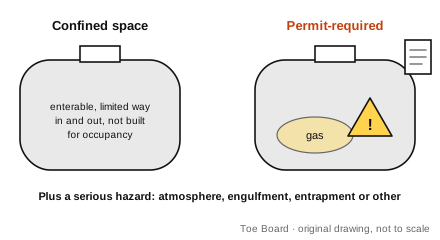
Use this diagram
Two tests, in order
First ask whether the space is confined at all: enterable, limited entry and exit, not built for continuous occupancy. Manholes, vaults, tanks, crawl spaces, pits and some attics qualify. Then ask whether it holds a hazard that makes it permit-required. The construction standard is 29 CFR 1926 Subpart AA, and the definitions are in 1926.1202.
A hazardous atmosphere under the rule includes oxygen below 19.5 percent or above 23.5 percent, flammable gas above 10 percent of its lower flammable limit, and toxic contaminants above their limits. The common testing order is oxygen first, then flammables, then toxics, because many flammable gas sensors need oxygen to read correctly.
Try one question
Question 1 of the free 10-question check on CHST. No signup. Then ask Kick, the AI study assistant, why the answer is right and the others are wrong.
Emergency Preparedness, Incident Investigation, and Response
On a building under construction, what is the longest allowed travel distance from any point of the protected area to the nearest fire extinguisher?
Press A-D or 1-4 to choose an answer while this question is on screen.
Choose an answer to begin
Who does what
- A competent person evaluates the site for confined spaces and permit spaces before work starts, under 1926.1203. See competent vs qualified person.
- The entry supervisor checks the permit's conditions, signs it and can cancel entry.
- The attendant stays outside, keeps count of entrants, keeps contact and summons rescue. The attendant does not go in to rescue.
- Authorized entrants know the hazards and get out when told or when something changes.
Rescue must be arranged before entry, under 1926.1211. A permit also lists other permits needed for the work, such as a hot work permit.
Ask Kick before you buy AI your AI study assistant
See what's on the CHST exam, test yourself with 5 quick questions, or find the plan that fits you.
The CHST course
Available now · instant accessLearn each CHST blueprint domain, then prove it on two full-length timed practice exams.
- 4modules of lessonsEvery task on the outline
- 2full-length timed exams200 questions in 240 minutes each
- 591practice questionsEach one explained
- 1week-by-week study planSet to your exam date
Turn a practice answer into a study step. In untimed practice, ask Kick AI about any question you answer, follow up, then see your weakest topics and what to drill next.
Instant access. Terms and refunds · Secure checkout by Stripe · Billed by Nori Software
Every answer comes with a full explanation.
Not every space stays a permit space
Subpart AA lets an employer use alternate procedures where ventilation alone keeps the only hazard, the atmosphere, under control, or reclassify a space as non-permit when every hazard is eliminated. Both have conditions and records. Read 1926.1203 for them in your own copy.
Common mix-ups
- Confined does not mean permit-required. Many confined spaces have no serious hazard.
- A hazard can come from the work. Welding, coating or running an engine inside can create the atmosphere hazard.
- Testing once is not enough. Conditions change, so monitoring continues.
- The attendant does not enter.
On the CHST exam
Confined spaces sit in the hazard and risk identification and control domain, 36.6% of the CHST, and rescue planning touches the emergency preparedness domain.
Practice it
The confined spaces guide maps every Subpart AA section. Trenches are covered separately in excavation protective systems, and every term in this set is in the CHST terms glossary.
Know the terms? Take the free 10-question check
Take the free 10-question check. It covers the four CHST domains, needs no signup and explains every answer, so you see which domain to study first. The CHST study guide shows where each topic fits in a six-week plan.
Not affiliated with or endorsed by BCSP.
Sources
Show the list
- 29 CFR 1926 Subpart AA, Confined Spaces in Construction, OSHA.
- CHST Examination Blueprint (CHST5, V.2022.04.12), Board of Certified Safety Professionals.
Facts come from the sources listed above. If something has changed, tell us and we will correct it within 2 business days.
Your next step
Ready to see where you stand on CHST?
Free, untimed and scored by domain. No signup.
Start the free 10-question checkCHST course. Lessons, timed practice exams and a plan around your exam date. Get CHST course · $149 See the plans or read the free sample lesson.Terms and refunds
Want a timed run? Try the free 25-question mini-mock. The first 5 need no email.
Prefer paper? Free printables
- Print a class quiz (free PDF). 5 practice questions with an answer key on page 2.
- Print the flashcards as cut-out cards (free PDF). The free flashcard sample, ready to cut and carry.
From the blog
- CHST practice questions: how many to do and how to review
- Leading vs lagging indicators in construction safety
- A job hazard analysis, step by step, with a worked example