Hazard communication: what it means for the CHST
Hazard communication, often called HazCom, is OSHA's rule that workers must be told about the hazardous chemicals they work with and how to protect themselves. It rests on four parts: a written program, container labels, safety data sheets and training. Chemical makers classify the hazards, and employers pass that information on to the people using the products.
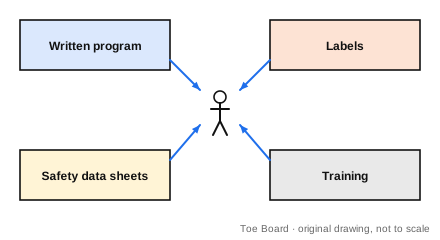
Use this diagram
Where the rule is
In construction, 29 CFR 1926.59 adopts the general industry standard, 1910.1200. OSHA aligned the rule with the Globally Harmonized System of Classification and Labelling of Chemicals in 2012 and updated it again in 2024. That is why labels and sheets now look the same from one supplier to the next.
Try one question
Question 1 of the free 10-question check on CHST. No signup. Then ask Kick, the AI study assistant, why the answer is right and the others are wrong.
Emergency Preparedness, Incident Investigation, and Response
On a building under construction, what is the longest allowed travel distance from any point of the protected area to the nearest fire extinguisher?
Press A-D or 1-4 to choose an answer while this question is on screen.
Choose an answer to begin
The four parts
- Written program. Lists the hazardous chemicals on site and explains how the employer handles labels, sheets and training, including how information is shared with other employers on a multi-employer site.
- Labels. A shipped container label carries the product identifier, a signal word (Danger for the more severe hazards, Warning for the less severe), hazard statements, pictograms in a red-bordered diamond, precautionary statements and the supplier's name and contact details. A container filled on site for the workplace needs at least the product identity and enough hazard information to warn the user.
- Safety data sheets. The full 16-section reference for each product, readily accessible on every shift. See safety data sheet.
- Training. At first assignment and whenever a new hazard is introduced: how to detect a release, the hazards, the protective measures, and how to read labels and sheets.
Ask Kick before you buy AI your AI study assistant
See what's on the CHST exam, test yourself with 5 quick questions, or find the plan that fits you.
The CHST course
Available now · instant accessLearn each CHST blueprint domain, then prove it on two full-length timed practice exams.
- 4modules of lessonsEvery task on the outline
- 2full-length timed exams200 questions in 240 minutes each
- 591practice questionsEach one explained
- 1week-by-week study planSet to your exam date
Turn a practice answer into a study step. In untimed practice, ask Kick AI about any question you answer, follow up, then see your weakest topics and what to drill next.
Instant access. Terms and refunds · Secure checkout by Stripe · Billed by Nori Software
Every answer comes with a full explanation.
How it works on a jobsite
A coating crew brings a product to a building that is still under construction. Under HazCom, their employer has the sheet, the containers are labeled, and their workers are trained. Under the multi-employer part of the program, the other trades nearby can learn about the hazard too. Some substances, like silica, also have their own standard with hazard communication duties written in; see silica Table 1.
Common mix-ups
- Danger and Warning are not interchangeable. Danger signals the more severe category.
- A pictogram alone is not a label. Every required element must be there.
- Training once at hire is not always enough. A new chemical hazard means new training.
- Unlabeled portable containers are allowed only for immediate use by the worker who filled them.
On the CHST exam
Chemicals and GHS sit in the hazard and risk identification and control domain, 36.6% of the CHST, and training duties touch the leadership, communication and training domain, 21%.
Practice it
Our health hazards guide places chemicals among the other health hazards. Every term in this set is in the CHST terms glossary.
Know the terms? Take the free 10-question check
Take the free 10-question check. It covers the four CHST domains, needs no signup and explains every answer, so you see which domain to study first. The CHST study guide shows where each topic fits in a six-week plan.
Not affiliated with or endorsed by BCSP.
Sources
Show the list
- 29 CFR 1910.1200, Hazard Communication, OSHA, including Appendix D on safety data sheets.
- 29 CFR 1926.59, Hazard Communication, OSHA.
- Hazard Communication, OSHA.
- CHST Examination Blueprint (CHST5, V.2022.04.12), Board of Certified Safety Professionals.
Facts come from the sources listed above. If something has changed, tell us and we will correct it within 2 business days.
Your next step
Ready to see where you stand on CHST?
Free, untimed and scored by domain. No signup.
Start the free 10-question checkCHST course. Lessons, timed practice exams and a plan around your exam date. Get CHST course · $149 See the plans or read the free sample lesson.Terms and refunds
Want a timed run? Try the free 25-question mini-mock. The first 5 need no email.
Prefer paper? Free printables
- Print a class quiz (free PDF). 5 practice questions with an answer key on page 2.
- Print the flashcards as cut-out cards (free PDF). The free flashcard sample, ready to cut and carry.
From the blog
- How to run a toolbox talk that crews actually listen to
- Incident investigation and root cause on a construction site
- A job hazard analysis, step by step, with a worked example