For welders and inspectors sitting CWI Part B
CWI Part B course and practice exams
Open book, on the clock: find it fast in the Book of Specifications.
Plans and prices
$385 to retake Part B at AWS vs $99 to prepare.
Exam dateOptional
Pick one and we'll suggest a plan.
Ask Tack about this course AI
Tap a question, or type your own. With Part B course: up to 40 messages a day.
Answers come from this course's own plans and contents.
- 20 drawn weld profiles to measure and call accept or reject
- 21 drills on finding the right clause in the Book of Specifications
- 7 modules of lessons with worked examples
Lifetime access, including your retake
The CWI exam fee is paid to AWS, not us: $1,255 for AWS members, $1,520 otherwise. An AWS retest costs $385 for Part B, $445 for A or C. Our prep for all three parts: $249. AWS 2026 price list.
Not ready? Try the free 10-question check
How this compares: price, renewal and refunds
How we prepare you for Part B
- 21 Book of Specifications drills
- 20 drawn weld profiles to measure and call accept or reject, with a new set whenever you want one
- 3 timed practice exams at real length: 46 questions, 120 minutes
- 7 modules of lessons
Tack, your AI study assistant, helps on Part B with a week-by-week plan from your exam date and weak areas, step-by-step walk-throughs and a weak-spot quiz.
Try 3 Part B questions
- 1. Worked example
A structural fillet weld replica has a face that dips inward between the toes. How should the inspector use a leaf-type fillet gauge to check its size?
Answer: B. Use the concave end with both tips on the members and check that its center point touches the weld face
On a concave fillet the throat, not the legs, limits the size, so the concave end is used: tips on both members, and the center point must touch the face for the blade size to be met. The leg end reads the legs, which can look full on a concave weld, and the longer leg would overstate size even on a convex weld. Toe to toe width is not fillet size. The V-WAC reinforcement step measures height above a surface, which does not apply to a fillet's throat.
Reference: AWS CWI Part B BOS 2017 clause 2.4 (structural fillet weld size); fillet gauge practice - 2. Welding Inspection and Discontinuities
On a pipeline replica, undercut reads 0.018 in, 0.027 in and 0.022 in at three places. Using an invented example limit of 0.025 in (not the book's value), which record is correct?
- 3. Procedure and Performance Qualifications
Use this invented rule, not the book's value: qualification lapses after 6 months without using the process. A welder qualified in GTAW on 1 Feb, used GTAW on 15 Apr, used SMAW on 1 Sep and used GTAW again on 20 Nov. What is the GTAW status on 20 Nov?
Other options
Have my manager pay instead
Everything in Part B course
Learn the tool kit, the specification and the qualification records, then practice.
- Everything in the practice pack, plus:
- 7 lesson modules covering every task in AWS's Part B outline
- 20 drawn weld profiles to measure and call accept or reject
- 2 worked calculations you can repeat with your own numbers
- 21 specification drills on finding the clause in the Book of Specifications
- A week-by-week study plan built from your free check and exam date
- Exam-day checklist: what to bring, allowed references and the calculator rules
- Written to AWS CWI Part B Book of Specifications (2017)
- Flashcards for every domain, with spaced review
- Tack, your AI study assistant
Best if: You want a structured path to the practical exam.
What's covered
- Measuring welds with the inspection tool kit (Outline topic B.1.1)
- Judging replicas against acceptance criteria (Outline topics B.1.2, B.1.3)
- Reviewing a WPS against its PQR (Outline topic B.2.1)
- Checking welder qualification records (Outline topic B.2.2)
- Bend specimens and test results (Outline topic B.3.1)
- NDE in the exhibits booklet (Outline topic B.4.1)
- Finding your way in the Book of Specifications (Outline topic B.5.1)
In Part B course
- 354original questions
- 3timed exams at real length
- 7modules of lessons
- 20weld profiles to call
See how Tack answers
A concave fillet weld's throat
Both legs of a fillet weld measure right on the gauge, but its face is dished in. What should you check next?
You: Why the throat? Both legs were the right size.
Tack: A dished-in face pulls the surface of the weld back toward the corner. So the shortest distance from the root to the face gets smaller, even while both legs still measure right. That shortest distance is what carries the load, so a concave weld can come up short with legs that look fine.
Key point: On a concave fillet, check the throat: it can fall short even when both legs measure right.
An original example, not an exam question. AI can be wrong, so check it against your course.
What members get
With the course and every bundle.
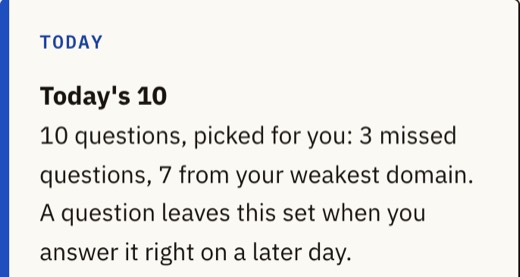 Today's 10 10 questions a day from your misses and your weakest domain, so what you got wrong comes back. Plus a missed set of up to 50.
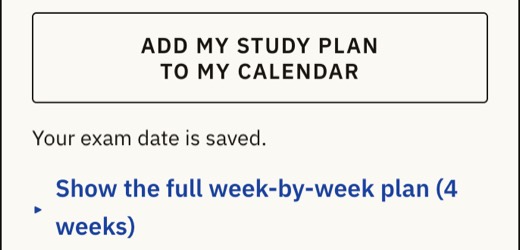 A plan to your exam date Set your date and get a week-by-week plan you can add to your calendar in one tap.
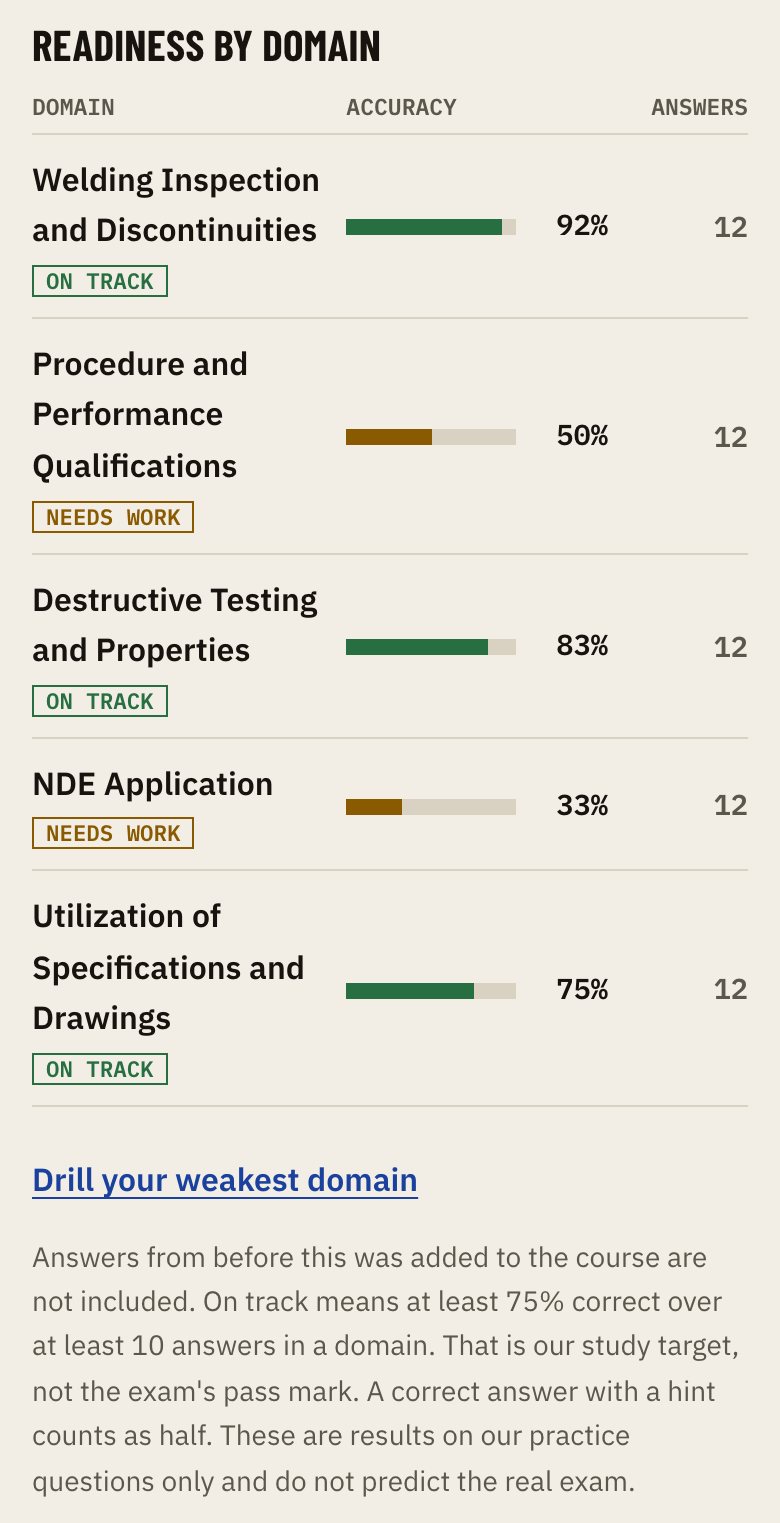
 Readiness by domain Your practice results against a 75% study target, and how they moved this week. A study target, not a pass prediction.
- Timed exams on the real clock. A live pace line, and Save and exit when you need a break. You pick up with the time you had left.
- Where your time went. After an open-book timed exam, your slowest questions become a practice set.
- An exam-day guide. What to bring, the references you may use and the calculator rules.
- 354 original questions, every one explained. Review every miss after each timed exam. Practice sets show you the ones you haven't seen first.
- Wrong answer key? We fix it within 2 business days and log it publicly.
- One payment. No subscription, nothing renews.
- Didn't pass? Every plan except the 7-day pass has lifetime access. Your retake prep is already paid for.
Look inside the course
The screens you get after checkout, with sample answers.
Book of Specifications lookupsDrill the lookup the exam keeps asking for: which annex, table or clause answers the question. The answer and the reason come straight after. Timed Part B form46 questions on the 120-minute clock, a flag on every question and a navigator that shows what you answered and flagged. Readiness by domainEach Part B domain rated from your own practice answers, with a one-click drill into the one that needs work. Practice results only, never a prediction of the real exam. Today's 10Ten questions a day, picked for you. A question you miss comes back on a later day until you get it right.
Practice drawn to the CWI Part B outline: every domain within 2 points of its exam weight
- Welding Inspection and Discontinuities40%
- Procedure and Performance Qualifications33%
- Destructive Testing and Properties9%
- NDE Application9%
- Utilization of Specifications and Drawings9%
See the numbers
Each domain's weight on the CWI Part B outline, as our timed exams draw it, beside its share of the 354-question bank.
| Domain | Outline | Bank |
|---|---|---|
| Welding Inspection and Discontinuities | 40% | 38% |
| Procedure and Performance Qualifications | 33% | 32% |
| Destructive Testing and Properties | 9% | 10% |
| NDE Application | 9% | 10% |
| Utilization of Specifications and Drawings | 9% | 10% |
AWS exam registration fees
AWS exam fees are paid to AWS, not us. Our prices cover Fillet Gauge prep, not the exam.
The AWS non-member exam-registration price includes 3 years of AWS membership; the AWS all-parts exam-registration fee includes Prometric seat fees.
AWS price listInstant access. Everything in the plan you choose opens as soon as checkout completes.
The free check uses the same question style and explanations as the course.
See the teaching before you buyRead a complete lesson from the course, “Measuring welds with the inspection tool kit”, and try a short practice set with full explanations. Free, no signup.
Read the free lessonWhat the course covers
7 modules, mapped to the task numbers in American Welding Society's published Part B content outline. Taught to AWS CWI Part B Book of Specifications (2017).
- Measuring welds with the inspection tool kit (Outline topic B.1.1)Fillet weld gauges and weld size · The V-WAC gauge, hi-lo gauge and dial caliper · Zeroing tools and reading them consistently
- Judging replicas against acceptance criteria (Outline topics B.1.2, B.1.3)Finding the right application clause: structural, pipeline or pressure piping · Weld profile and discontinuity criteria in a specification · Recording a reject with the clause that decides it
- Reviewing a WPS against its PQR (Outline topic B.2.1)What a procedure record must show · Essential variables and qualified ranges · Spotting a WPS that exceeds its PQR
- Checking welder qualification records (Outline topic B.2.2)What a welder qualification record must show · Positions, thickness and diameter qualified · When a welder's qualification lapses
- Bend specimens and test results (Outline topic B.3.1)How bend specimens are cut and ground · Judging bend and tension results against criteria
- NDE in the exhibits booklet (Outline topic B.4.1)Recognizing an NDE method from a photograph · Reading an NDE report
- Finding your way in the Book of Specifications (Outline topic B.5.1)How the Book of Specifications is organized · Annex tables: groupings, numbers and pipe schedules · Drawings, symbols and narratives in a question
Questions
When do I get access?
Straight away. Checkout takes you to your course, and the receipt email has the same link.
How do I get back into my course?
Use the link in your receipt email. If you can't find it, enter your email on the course page and we resend it to the address on your order.
Is 354 questions enough?
Each one comes with a worked explanation and its reference. You also get 21 end-of-module checks, 21 specification drills, 20 weld profiles and 2 worked calculations. Today's 10 and your missed set bring your misses back on later days, so you work the bank instead of reading it once.
Can I get a refund?
Eligibility depends on your plan, when you request a refund and your paid use. See the refund terms for the conditions and exceptions.
How long do I keep access?
Lifetime access: your access has no end date. Updates are included, so if American Welding Society moves this exam to a newer code edition while you have access, your course moves with it. The 7-day pass is the exception. 7-day pass: access ends 7 days after payment, to the minute. It does not renew and is not a subscription. A timed practice exam started before then can still be finished.
Which editions does the course use?
The questions are written to AWS CWI Part B Book of Specifications (2017). The Book of Specifications is a free PDF from AWS.
More questions (14)
If I buy the 7-day pass now, is its price taken off a bigger plan later?
No. Each plan is a separate purchase at its listed price, and the $29 paid for the 7-day pass is not credited toward another plan. With more than a week before your exam, a full plan is the better buy.
What is the difference between the practice pack and the course?
The practice pack is the question bank and the timed practice exams. The course adds a lesson for every task in American Welding Society's content outline, worked calculations, specification drills, a study plan built from your free 10-question check and an exam-day checklist. If any domain scored under about 60%, take the course.
Are the questions copied from the exam?
No. Every question is original and written to American Welding Society's published content outline. Exam content is confidential and we never use it. We are not affiliated with or endorsed by AWS, ICC or AISC.
How are the questions written?
In our own words, to AWS's current published outline. See how many questions cover each domain.
Do I need my own copy of AWS D1.1?
For Part C, no. AWS provides D1.1:2025 on screen as a PDF, so you do not need a printed copy. The course cites sections by number so you practice finding them, and we never reproduce the code's text. Parts A and B need no copy: Part A is closed book and Part B gives you its Book of Specifications.
What is the Part B task?
You judge weld replicas with a gauge kit against a specification, the AWS Book of Specifications. That is the task our Part B course trains.
In what order do I take the three parts?
Part B comes first. You book it with your application, at an AWS test site, in one of three fixed daily groups that check in at about 7:00 a.m., 10:45 a.m. or 2:45 p.m. Late arrivals are not moved to another group. About 4 to 6 weeks after you apply, AWS emails a confirmation letter with the eligibility codes you use to book Parts A and C at Prometric.
What score do I need to pass?
AWS requires 72% on each part and 72% overall, the average of the three parts. Scores are rounded down to the nearest whole percent.
What if I need a retest?
Your access has no end date, so your course, your scores and your missed set are still there. AWS allows up to 3 retests in 3 years from your first test date. The second and third need proof of more training first. A Part C retest uses the same code as your first Part C.
Why is this so much less than a seminar?
We teach online, so there is no classroom, travel or time off work. You get lessons, drills and timed exams on your phone or computer, and they stay yours.
What does the CWI exam fee cover?
AWS prices members and non-members separately. The non-member price includes a 3-year AWS membership. The all-parts fee also includes the Prometric seat fees, $60 each for Parts A and C.
Can my employer pay?
Yes. Pay at checkout and we email a receipt you can expense, or download a reimbursement request to send your manager.
Is Tack AI?
Yes. Tack is an AI study assistant, not a person or an instructor. Check important details against your lessons and references.
Can you promise I will pass?
No, and nobody honest can. We promise everything listed in your plan, and a fix within 2 business days for any wrong answer key.
Employer paying?
Many employers fund CWI Part B prep. Generate a reimbursement request PDF to send to your manager. Buying for a crew? Request a quote
Free practice
Drawn weld profiles with undercut, overlap, convexity, underfill and misalignment. Read the scale, then make the call.